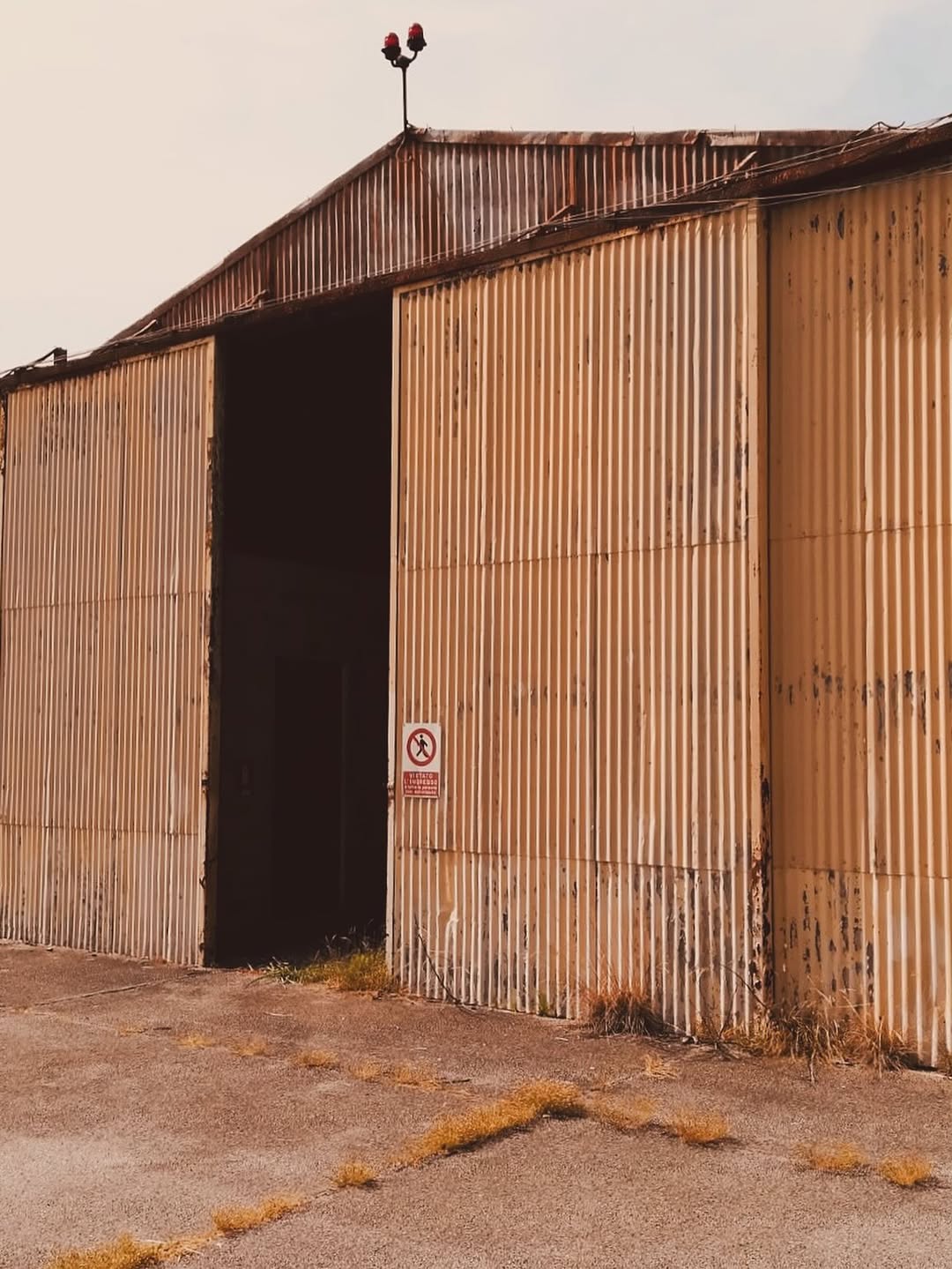
Councilor Antonio Bressa inspects the former hangar at Padua Airport
On Tuesday, October 7, 2025, students from the two Interior Design Laboratories of the three-year degree course in Product Design, Visual Communication, and Interior Design at the IUAV University of Venice visited the former hangar at Padua Gino Allegri Airport, the case study chosen for the current academic year.
The initiative marked the beginning of a research and design project dedicated to the reuse of large containers undergoing restoration, aiming at imagining new forms of interiority and sociality in a formerly technical space.
This perspective includes the commitment of the management company Heron Air, which works constantly to bring Padua Airport to the city’s level of excellence. Heron Air’s mission is not limited to ensuring the operational and infrastructural efficiency of the airport but aims to change it into a true hub of innovation, culture, and relationships. Opening up to students, professionals, and creative entities in the area is in line with this vision: to make the airport not only a strategic hub for air traffic, but also an urban laboratory capable of connecting communities, research, and experimentation.
During their visit, students had the opportunity to observe and analyze the space, ask questions and formulating initial design ideas. They were joined by Councilor Antonio Bressa, urban planner Adriano Bisello, and Graundstudio, a communications agency that recently launched a pilot project dedicated to music as the first experiment in reusing one of the hangars. Their experience will provide an opportunity to discuss the relationship between contemporary creativity and new scenarios for regeneration.
The workshop, led by IUAV professors, is a continuation of previous experiences: in recent years, the Interior Design course led by Silvia Codato led to the conception and realization of the Microfestival dell’Abitare in Padua. This widespread project involved citizens, associations, and local organizations, temporarily transforming urban and residential spaces into places for meeting, discussion, and creativity. Through installations, performances, and micro-exhibitions, the festival experimented with new ways of inhabiting the city, intertwining design, participation, and material culture.
The new path embarked upon with the former hangar now aims to develop design skills capable of combining memory and transformation, restoring the site to an active role in the contemporary city. The educational dimension is thus intertwined with dialogue with institutions, professionals, and cultural operators, offering students an opportunity for direct learning in the field and dialogue with the various actors involved in the regeneration processes.
The site visit on October 7th marked the beginning of a journey that will lead, over the course of the year, to the definition of innovative and sustainable interior design projects capable of redefining the future of a place that is emblematic for Padua.
Labs involved
The Interior Design A workshop – Prof. Silvia Codato with Davide Cecconello and Elisabetta Gabrielli integrated into the Environmental Quality module Prof. Francesca Cappelletti with Francesca Cremasco and Erika Guolo
The Interior B workshop – Prof. Alessandra Bosco with Francesca Ambrogio and Pietro Lora integrated into the Environmental Quality module Prof. Piercarlo Romagnoni with Francesca Cremasco and Erika Guolo



 Pirde of Vigonovo: Sergio Rodella at the Sagrada Familia